Pages

Wednesday, March 17, 2010

Anti-Islam Leader Does Well In Dutch Vote

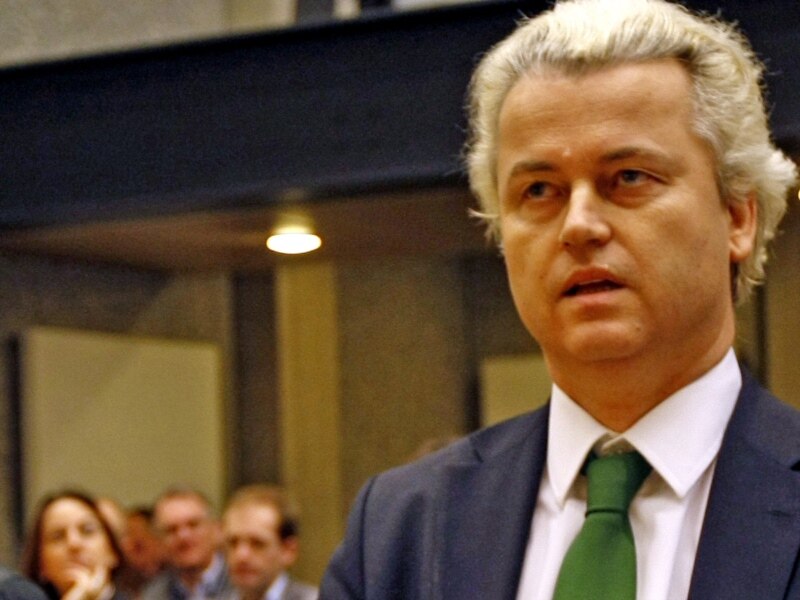
The popularity of Geert Wilders, known for his repeated public statements attacking Muslims, has dented the image of the Netherlands as a country that has often portrayed itself as a bastion of tolerance.

March 04, 2010
(RFE/RL) -- Early returns in Dutch municipal elections showed the party known for its tough stances on immigration and Islam making big gains in a result seen as a possible foreshadowing of upcoming national elections.

Preliminary results showed that the Party for Freedom (PVV) of Geert Wilders came first in Almere, east of the capital, Amsterdam, and second in The Hague behind the Labor Party (PvdA).

Speaking to supporters today, Wilders said, "What is possible in The Hague and Almere is possible all over the country." He added that, in the national vote, "we will become the biggest party in the Netherlands."

Full results won't be certified until March 5.

Political Gridlock


Wilders' party, set up in 2006 to "stop the Islamization of the Netherlands," contested only those two cities in its first municipal election on March 3, three months ahead of early general elections on June 9.

The center-left national government collapsed last month, when the PvdA withdrew from the ruling coalition in a spat with the Christian Democratic Appeal (CDA) over extending the Dutch military mission in Afghanistan.

Outgoing Prime Minister Jan Peter Balkenende has said the 1,600 Dutch troops serving with the NATO-led force in the province of Oruzgan were now likely to withdraw in August as planned.

The PvdA appeared to have benefited from its stance over Afghanistan. Its leader, former Deputy Prime Minister Wouter Bos, told supporters, "We were declared dead and buried, but with our struggle, humility and ideals we have come back."

"The Labor Party today is without any doubt the leading progressive party in the Netherlands," Bos added. "It gives us hope and confidence for June 9."

An opinion poll showed that the PVV would win the most seats -- 27 in the 150-member Dutch parliament -- in the June 9 election. But most left-leaning parties have already said they would not work with Wilders.

Political observers say that, with the country's two main parties, the CDA and PvdA, at odds, and other parties split equally between left and right, it may prove very difficult for either side to build a workable coalition.

Wilders' party came in second in the European elections of June 2009 with 16.7 percent of the vote behind the CDA.

Enemy Of Islam

The popularity of Wilders, known for his repeated public statements attacking Muslims, has dented the image of the Netherlands as a country that has often portrayed itself as a bastion of tolerance.

Muslims make up about 6 percent of the population, and Wilders says their presence threatens the Dutch way of life.

Wilders' 17-minute film stigmatizing Islam, "Fitna," received worldwide attention in 2008 when its release on the Internet sparked condemnation by authorities in Afghanistan, Iran, Indonesia and Pakistan.

The film, whose title means "strife" in Arabic, juxtaposes verses from the Koran with images of beheadings, attacks by Islamic terrorists, and clerics calling for jihad.

A year ago Wilders was turned back at London's Heathrow Airport because, authorities feared his visit would incite violence. He was allowed into Britain several months later after a court overturned the ban.

Wilders is awaiting trial in the Netherlands for allegedly inciting racial hatred with remarks that include equating the Koran and Islam with the ideology of Nazism and Adolf Hitler's book "Mein Kampf." Wilders has claimed he was the victim of "an attack on freedom of expression."
http://www.rferl.org/content/AntiIslam_Leader_Does_Well_In_Dutch_Vote/1974315.html

Wednesday, March 3, 2010

Kartika disebat atau diampun?

Utusan Malaysia 4 Mac 2010 / 18 Rabiul Awal 1431

Kartika Sari Dewi (kiri) gembira ketika keluar dari bangunan MUIP setelah mengadakan pertemuan tertutup dengan Tengku Mahkota Pahang di Pekan, semalam. - utusan/Mahathir Ali


PEKAN 3 Mac - Teruskan hukuman sebat atau diberi pengampunan oleh Sultan Pahang, Sultan Ahmad Shah.

Itu nasib yang mungkin bakal dilalui bekas model sambilan, Kartika Sari Dewi Shukarnor, 33, yang dijatuhi hukuman sebat oleh Mahkamah Tinggi Syariah Kuantan kerana meminum arak tahun lalu.

Tengku Mahkota Pahang, Tengku Abdullah Sultan Ahmad Shah bertitah, walaupun telah dijatuhi hukuman, Kartika Sari Dewi masih berpeluang mengemukakan rayuan kepada Sultan Pahang selaku ketua agama Islam negeri ini untuk mendapatkan pengampunan.

Baginda bertitah, di bawah Seksyen 133, Enakmen Tatacara Jenayah Syariah Negeri Pahang 2002, Sultan Pahang, atas nasihat mufti boleh meringan atau memberi pengampunan kepada mana-mana pesalah syariah tanpa persetujuan orang yang telah dihukum.

Sehubungan itu, titah baginda, pihaknya akan menunggu terlebih dahulu keputusan Sultan Ahmad Shah dan juga Kartika Sari Dewi sendiri sama ada mahu menggunakan peluang yang ada bagi mengemukakan rayuan untuk mendapatkan pengampunan.

"Kita akan menunggu dalam masa terdekat, kalau tidak ada rayuan daripada pihak Kartika, kita akan meneruskan (pelaksanaan hukuman) dan juga saya akan persembahkan kepada Sultan minit mesyuarat (hasil pertemuan) hari ini dalam masa sehari dua ini dan daripada situ, tindakan akan diteruskan," titah baginda.

Baginda bertitah demikian kepada pemberita selepas menerima menghadap Kartika Sari Dewi yang ditemani bapanya, Shukarnor Abdul Mutalib di pejabat Majlis Ugama Islam dan Adat Resam Melayu Pahang (MUIP) di sini hari ini.

Dalam pertemuan selama kira-kira sejam itu, Tengku Abdullah yang juga Yang Dipertua MUIP bertitah, baginda telah mendengar isi hati Kartika Sari Dewi dan bersimpati dengan tekanan yang dihadapinya.

Justeru titah baginda, tindakan seterusnya akan diambil bagi menyelesaikan masalah tersebut secepat mungkin.

"Kita tidak mahu berlarutan dan saya simpati dengan pihak Kartika dengan tekanan yang dihadapi. Ini adalah satu kes yang boleh kita perhalusi dari segi kelemahan yang terdapat dalam pelaksanaan hukuman ini," titah baginda.

Dalam pada itu, Tengku Abdullah bertitah, MUIP akan mengkaji semula pelaksanaan undang-undang syariah yang telah termaktub begitu lama di negeri ini berikutan masih terdapat beberapa kelemahan.

"Kita akan kaji semula supaya kita nampak juga hukuman syariah ini ada sifat-sifat perikemanusiaan, tidak semestinya (hukuman dijatuhkan) mandatori.

"Kita akan kaji tahap kesalahan supaya hukuman syariah ini lebih mulia, lebih murni bukan sekadar menangkap dan hukum.

"Kita juga ada proses, mungkin kaunseling dan pendidikan supaya kita dapat mendidik," titah baginda.

Mengenai kesan hukuman sebat itu ke atas industri pelancongan Pahang, Tengku Abdullah bertitah, baginda sememangnya memandang serius perkara tersebut.

Baginda bertitah, tetapi pada masa sama Sultan Pahang mengingatkan pihak-pihak tertentu supaya tidak mengambil kesempatan atas keterbukaan yang ada dengan mengadakan pesta atau aktiviti sewenang-wenangnya tanpa memahami budaya tempatan.

Baginda turut mengingatkan pegawai penguat kuasa agama tidak menyalahgunakan kuasa apabila sewenang-wenangnya menangkap orang sehingga boleh mengaibkan mereka.

"Saya bukan hendak menyokong pihak-pihak yang hendak promosikan pelancongan di sini tetapi biarlah ada batasan sedikit.

"Dalam hubungan ini, saya akan berbincang dengan pihak kerajaan dalam masa terdekat," titah baginda.

Dalam pada itu, usaha mendapatkan reaksi daripada Kartika Sari Dewi yang menginap di Inderapura Lake Resort dekat sini, gagal apabila difahamkan beliau dinasihati tidak dibenar memberi sebarang kenyataan kepada media pada masa ini.

Wednesday, February 3, 2010

Prayers and Criticism in Wake of Detroit Imam’s Killing by F.B.I.

Fabrizio Costantini for The New York Times

Omar Regan, a comedian and son of Imam Luqman Ameen Abdullah of Detroit, led prayers Friday at a makeshift mosque after his father died in an F.B.I. raid.

SUSAN SAULNY
Published: October 30, 2009

DETROIT — Friday prayers were intoned on schedule at the red brick two-story house on the west side that is a makeshift home for the Masjid Al-Haqq mosque.

Fabrizio Costantini for The New York Times

A home in Detroit was one of several locations raided by the F.B.I. on Wednesday.

Muslim Alliance of North America

The F.B.I. says Mr. Abdullah was a separatist Muslim intent on overthrowing the United States government.

But leading the prayers was a son of the mosque’s imam, Luqman Ameen Abdullah, who was killed by federal agents in a raid on Wednesday. The son, Omar Regan, 36, a comedian and motivational speaker, flew from Los Angeles to mourn and defend his father, who was described in federal court papers as a separatist Muslim intent on overthrowing the United States government.

“My father was a sharp-tongued individual,” Mr. Regan said. “He would talk about his dislike of the government, about how law enforcement wasn’t protecting and serving the people. But speaking his emotions and acting on his emotions are two different things.”

Mr. Regan’s sentiments were echoed by many Muslims here and across the country on Thursday and Friday, as some leaders portrayed the Federal Bureau of Investigation’s counterterrorism squad of using heavy-handed tactics against Mr. Abdullah, who was not accused of terrorism.

Asked why Mr. Abdullah had not been charged with terrorism, the United States attorney for the Eastern District of Michigan, Terrence Berg, said, “The charges speak for themselves.”

Mr. Abdullah, 53, died in a shootout in the raid of a warehouse just outside the city, in Dearborn, where he stored goods. The raid was one of three in which federal agents said were intended to arrest Mr. Abdullah and 10 other men on charges that included conspiracy to sell stolen goods, mail fraud and illegal possession of firearms. But the authorities said Mr. Abdullah, who had a lengthy criminal record and was forbidden to have a firearm, opened fire on the agents.

He died of multiple gunshot wounds, said a spokesman for the Wayne County coroner.

“I’m comfortable with what our agents did,” said Andrew G. Arena, special agent in charge of the Detroit division of the F.B.I. “They did what they had to do to protect themselves.”

Two of the 11 defendants remain at large; one, Mujahid Carswell, 30, another son of Mr. Abdullah, was arrested Thursday in Canada. (Law enforcement officials said Mr. Abdullah’s shots killed an F.B.I. dog, Freddy, who is to be honored for dying in the line of duty, officials said.)

A 43-page criminal complaint described Mr. Abdullah as the belligerent leader of a faction of a group called the Ummah, meaning “the Brotherhood,” which advocates the establishment of a separate nation governed by Islamic laws within the United States. The authorities had been monitoring him for years.

In January, city officials evicted Mr. Abdullah’s mosque, which counts about 25 families as members, from its original location for failure to pay property taxes. He relocated to the two-story home on the west side. During the eviction, the police said, officers found two guns and about 40 other weapons in Mr. Abdullah’s apartment.

Law enforcement officials said they were concerned about retaliation in the wake of Mr. Abdullah’s death.

But the federal complaint on which Wednesday’s raid was based also shows how much trouble Mr. Abdullah and his associates had in executing even basic criminal schemes, like switching the vehicle identification numbers on a stolen truck, or selling stolen laptops. While full of bravado, they are characterized in the complaint as being a far cry from masterminds, a notion that some of Mr. Abdullah’s acquaintances supported.

“They knew a long time ago that this was a penny ante operation, and they could have stopped it,” Abdullah El-Amin, an imam at the Muslim Center, Detroit’s largest black mosque, said of federal authorities. “It didn’t have to get to this point, people getting killed.”

Mr. El-Amin said he had known Mr. Abdullah for more than 20 years, although they had never attended the same mosque. Mr. El-Amin said he had heard Mr. Abdullah talk about wanting a separate state, but described it as “sort of like the Pennsylvania Dutch have their own communities and stuff.” Some, but not all, mainstream Muslim leaders agreed that Mr. Abdullah had held that view.

“The very incendiary rhetoric that the F.B.I. alleges, I never heard that from him,” said Dawud Walid, executive director of the Michigan chapter of the Council on American-Islamic Relations. “There was nothing extraordinary about him.”

The Muslim Public Affairs Council, a policy and advocacy group based in Los Angeles, is calling for an investigation of Mr. Abdullah’s killing, which it describes as “deeply disturbing.”

But Eide A. Alawan, director of the office of interfaith outreach at the Islamic Center of America, one of the largest Muslim centers in the Midwest, in Dearborn, took a critical view of Mr. Abdullah and his defenders.

“This is not the first time in history that someone has used a religion to do some harm in the name of faith,” Mr. Alawan said. “Now is an opportune time for some to show their militancy. It gets attention. But it’s no different than the Ku Klux Klan in the 40s and 50s using the cross.”

The Muslim Alliance in North America, a national network based in Lexington, Ky., expressed shock at the killing of Mr. Abdullah, who served on its governing body.

“Reference to the Ummah as a ‘nationwide radical fundamentalist Sunni group consisting primarily of African-Americans’ is an offensive mischaracterization,” the group said in a statement.

“To those who have worked with Imam Luqman A. Abdullah,” it continued, “allegations of illegal activity, resisting arrest, and ‘offensive jihad against the American government’ are shocking and inconsistent. In his ministry he consistently advocated for the downtrodden and always spoke about the importance of connecting with the needs of the poor.”

A funeral for Mr. Abdullah is scheduled for Saturday at the Muslim Center in Detroit.

Mary M. Chapman contributed reporting from Detroit, and Emma Graves Fitzsimmons from Chicago.

http://www.nytimes.com/2009/10/31/us/31dearborn.html

Friday, January 1, 2010

Danish police shoot intruder at cartoonist's home

Kurt Westergaard Sept 2006
Kurt Westergaard has had a price on his head since 2006


Danish police have shot and wounded a man at the home of Kurt Westergaard, whose cartoon depicting the Prophet Muhammad sparked an international row.

Mr Westergaard was at home in Aarhus when a man broke in and threatened him. He pressed a panic button and police entered the house and shot the man.

Danish officials said the intruder was a 28-year-old Somali linked to the radical Islamist al-Shabab militia.

The cartoon, printed in 2005, prompted violent protests the following year.

ANALYSIS
Malcolm Brabant
By Malcolm Brabant, BBC News
This attack will force the Danish secret service Pet to review whether their protection is adequate.

Mr Westergaard's house was supposed to have been turned into a fortress. The windows were supposed to be blast proof, and yet a determined individual came within a whisker of killing a man regarded by Islam as a pariah, but by his supporters, as one of the bravest defenders of free expression.

One of 12 cartoons published in the Danish newspaper Jyllands Posten, it depicted the Prophet Muhammad with a bomb in his turban.

In 2006 the paper apologised for the cartoons, but other European media reprinted them.

Danish embassies were then attacked by Muslims around the world and dozens killed in riots.

Mr Westergaard went into hiding amid threats to his life, but emerged last year saying he wanted to live as normal a life as possible.

His house has been heavily fortified and is under close police protection.

http://news.bbc.co.uk/2/hi/europe/8437433.stm


Monday, November 30, 2009

Rights watchdog hints Swiss minaret ban could go

GENEVA – A Swiss ban on minarets could violate fundamental liberties, Europe's top human-rights watchdog said Monday in an indication that the heavily criticized vote could be overturned.

The Council of Europe said banning "new minarets in Switzerland raises concerns as to whether fundamental rights of individuals, protected by international treaties, should be subject to popular votes."

The statement by the 47-nation council's secretary-general, Thorbjorn Jagland, suggests a case may be made to seek a ruling by the European Court of Human Rights condemning Switzerland for violating freedom of expression, freedom of religion and prohibition of discrimination.

Swiss Justice Minister Eveline Widmer-Schlumpf said the ban would come into force immediately, but also indicated that the court could strike down the Sunday vote, which incurred swift condemnation at home and abroad for banning the towers used to put out the Islamic call to prayer.

"The ban contradicts the European Convention on Human Rights," Zurich daily Blick cited Widmer-Schlumpf as saying, referring to the 1950 treaty laying out basic rights that the court in Strasbourg, France, was created to ensure member states abide by.

The referendum backed by nationalist parties was approved by 57.5 percent of the population Sunday, forcing the government to declare illegal the building of any new minarets in Switzerland. It doesn't affect the country's four existing minarets.

France's Foreign Minister Bernard Kouchner said he was "a bit scandalized" by the vote, which amounts to "oppressing a religion."

"I hope that the Swiss will go back on this decision rather quickly," Kouchner said on France's RTL radio. "It is an expression of intolerance, and I detest intolerance."

The U.N.'s special investigator on religious freedom, Asma Jahangir, said the ban on new minarets constitutes "a clear discrimination against members of the Muslim community in Switzerland."

Ekmeleddin Ihsanoglu, the secretary general of the Organization of the Islamic Conference, called the ban an "example of growing anti-Islamic incitement in Europe by the extremist, anti-immigrant, xenophobic, racist, scare-mongering ultra-right politicians who reign over common sense, wisdom and universal values."

Wealthy Arab tourists might think twice now about spending their money in Geneva and other Swiss cities popular with visitors from the Gulf, and the neutral country's efforts to mediate in the Israeli-Palestinian conflict could also suffer, said Daniel Warner, a Swiss-American political scientist at the Graduate Institute in Geneva.

Arriving at a meeting of European Union justice ministers, Widmer-Schlumpf argued the vote was not "a referendum against Islam ... but a vote directed against fundamentalist developments."

She defended the referendum as being "about minarets and not, of course, about the Islamic community," she said. "We are interested in a multi-religious society in Switzerland."

Supporters of the ban said the number of Muslims in Switzerland had grown sharply from 50,000 in 1980, but it is still only 4 percent of the 7.5 million population, many of whom don't practice. Western Europe has an estimated 14 million Muslims.

Voting figures showed a rural-urban split in the Swiss vote, with only 38.6 percent of people in major cities backing the ban compared with about two-thirds of the population in smaller towns and villages, officials said.

Anne-Marie Birnstiel, in the wealthy Alpine town of Gstaad told AP Television News she was disappointed by the vote and afraid of the consequences for Switzerland.

But, fellow town resident Anton Seil told APTN that "we are in Switzerland, and if I go to another country I also can't build up my church or represent my faith. So, they have to adapt to us in Switzerland too."

Switzerland isn't alone in expressing fears about a growing Muslim population, though it is the only country where voters can easily enact constitutional amendments through referendums.

France, too, has enacted laws that Muslims claim are directed at them, including a ban on the wearing of religious symbols, such as headscarves, in schools.

A leader of Italy's Northern League party, a key ally in Premier Silvio Berlusconi's conservative coalition, said: "Unfortunately we are faced with a strong attack on (our Christian) identity by an intolerant religion like Islam is." He said he advocated putting a symbol of a cross on the Italian flag.

The Roman Catholic Church, however, condemned the vote.

Monsignor Antonio Maria Veglio, a Vatican official with the Pontifical Council on Migrants, told the Italian news agency ANSA that he shared the position taken by Swiss bishops who called the vote a "hard blow to religious freedom and immigration."

Overnight, opponents of the minaret ban lit candles in front of the Swiss parliament in Bern and hung up banners saying "This is not my Switzerland."

In Zurich, unknown people smashed a glass door of the offices of the nationalist Swiss People's Party — which had backed the ban — cantonal (state) police said.

____

Associated Press writers Robert Wielaard in Brussels, Rod McGuirk in Jakarta, Ingrid Rousseau in Paris, Maamoun Youssef in Cairo, Zeina Karam in Beirut, Frances D'Emilio in Rome and APTN producer Dorothee Thiesing in Gstaad contributed to this report.


http://www.youtube.com/watch?v=cG4p90KYfTQ

Sunday, November 29, 2009

Rare rainstorms snarl Islam’s annual hajj, soaking millions of pilgrims

Rare, heavy rains soak pilgrims at Islam’s hajj

JIDDAH, Saudi Arabia — Rare, heavy rainstorms soaked pilgrims and flooded the road into Mecca, snarling Islam’s annual hajj as millions of Muslims headed for the holy sites. The downpours add an extra hazard on top of intense concerns about the spread of swine flu.

Pilgrims in white robes holding umbrellas, some wearing face masks for fear of the flu, circled the black cube-shaped Kaaba in Mecca, the opening rite for the hajj. But the shrine — Islam’s holiest site — and the nearby, rain-soaked streets did not see the usual massive crowds, because many tried to stay inside nearby hotels or were caught up in the traffic jams heading into the city.

The hajj — a lifetime dream for Muslims to cleanse their sins — is always a logistical nightmare, as a population the size of a small city moves between Mecca and holy sites in the nearby desert over the course of four days.

In the past, the rites have been plagued by deadly stampedes caused by congestion as the massive crowds perform the rituals — and Saudi authorities Wednesday were clearly concerned the rains could worsen the potential dangers. Civil authorities urged pilgrims to move cautiously and not to rush.

This year has brought the added worry that the massing of more than 3 million people from around the world could bring a swine flu outbreak. For months ahead of the pilgrimage, the Saudi government has been working with the United States’ Center for Disease Control and Prevention to set up clinics and precautionary measures to stem any outbreak.

So far, four pilgrims have died from the H1N1 virus since arriving in Saudi Arabia in recent days, and 67 pilgrims have been diagnosed with the virus, Saudi Health Minister Abdullah al-Rabeeah told the Arab news network Al-Jazeera English.

Shahul Ebrahim, a consultant from the Atlanta, Georgia-based CDC at the hajj, said it was too early to tell if the rains could exacerbate the spread of H1N1, the flu virus.

“Rain can lead to other waterborne diseases … such as the common cold, flu. But we still don’t know how it will effect H1N1. We can’t predict,” he told The Associated Press.

So far, the rain was mainly just causing traffic snarls. Winter is the rainy season in Mecca, and light showers are not uncommon, but such a heavy downpour has not been seen for years during hajj. The pilgrimage takes place according to Islam’s lunar calendar, and so rotates through the year.

Civil Defense spokesman Maj. Abdullah al-Harthi said his organization has plans ready to deal with flooding, including 300 buses to evacuate pilgrims if necessary. He said no casualties have been reported from the rains, the official Saudi Press Agency reported.

One lane of the main road into Mecca was closed by flooding, reducing it to one lane, said Amer al-Amer, an Interior Ministry spokesman. “It cannot handle the pressure of all the people coming from outside Mecca,” he said, adding that it would cause delays of several hours for people trying to reach the sites.

The numbers of pilgrims are expected to exceed last year, when some 3 million attended, al-Amer told AP.

Streets were flooded in the Red Sea coastal city of Jiddah, the entry point for many pilgrims. Pilgrims on Wednesday were making their way to Mecca to perform the circling of the Kaaba and to the nearby desert valley of Mina, where a sprawling tent city has been set up for them to live in.

Water covered the floors in many of the tents, said Suleiman Hamad, a 29-year-old pilgrim in Mina. He said the scene was “muddy, but manageable,” with many pilgrims throwing blankets over their heads when they walked outside.

Rain fell sporadically throughout the day, and stopped by late afternoon in many sites — though it continued to fall in Mecca. Al-Amer and other authorities were optimistic that flooded areas would dry by evening.

On Thursday, the mass of pilgrims will flock to Mount Arafat, a plateau outside Mecca where the prophet Muhammad delivered his farewell sermon. They then proceed to Mina, where over the next three days they perform a rite stoning three stone walls in a symbolic rejection of the devil.

http://blog.taragana.com/n/rare-rainstorms-snarl-islams-annual-hajj-soaking-millions-of-pilgrims-235698/

Thursday, October 29, 2009

Muslim leader killed in US raid

The FBI raid against Abdullah and his followers was in response to a series of criminal charges

The leader of a Sunni Muslim group advocating Islamic rule in the US has been shot dead by federal agents during a raid in the city of Detroit, authorities have said.

Luqman Ameen Abdullah, 53, was killed on Wednesday during a shootout with officers from the Federal Bureau of Investigation (FBI) at a warehouse in Dearborn, the US attorney's office said.

The FBI was pursuing Abdullah and 10 followers on charges that include conspiracy to sell stolen goods and the illegal possession and sale of firearms.

A court document said that Abdullah - also known as Christopher Thomas by the authorities - was an imam of a group whose mission is to establish Sharia (Islamic law) within the US.

Exchange of fire

"At one location, four suspects surrendered and were arrested without incident. Luqman Ameen Abdullah did not surrender and fired his weapon. An exchange of gun fire followed and Abdullah was killed," the FBI statement said.

Abdullah regularly preached anti-government rhetoric and some of his supporters had converted to Islam while in prison, the FBI said.

Dawud Walid, the executive director of the Council on American-Islamic Affairs, said that members of the Muslim community were "shocked" at Abdullah's death.

"He was well-known and respected. No-one that I have talked has said that he was linked to any sort of extremist groups, overseas or here at home," he told Al Jazeera.

"I do not have any knowledge as to the veracity of the allegations [against Abduallah and his 10 followers] but if the allegations are true, what does that have to do with Islam or Muslims?

"The charges that have been filed against the 11 suspects have no relation or linkage to their religion - they are gun charges. We resent the fact that the FBI has linked religion to these gun charges."

Source: Al-Jazeera